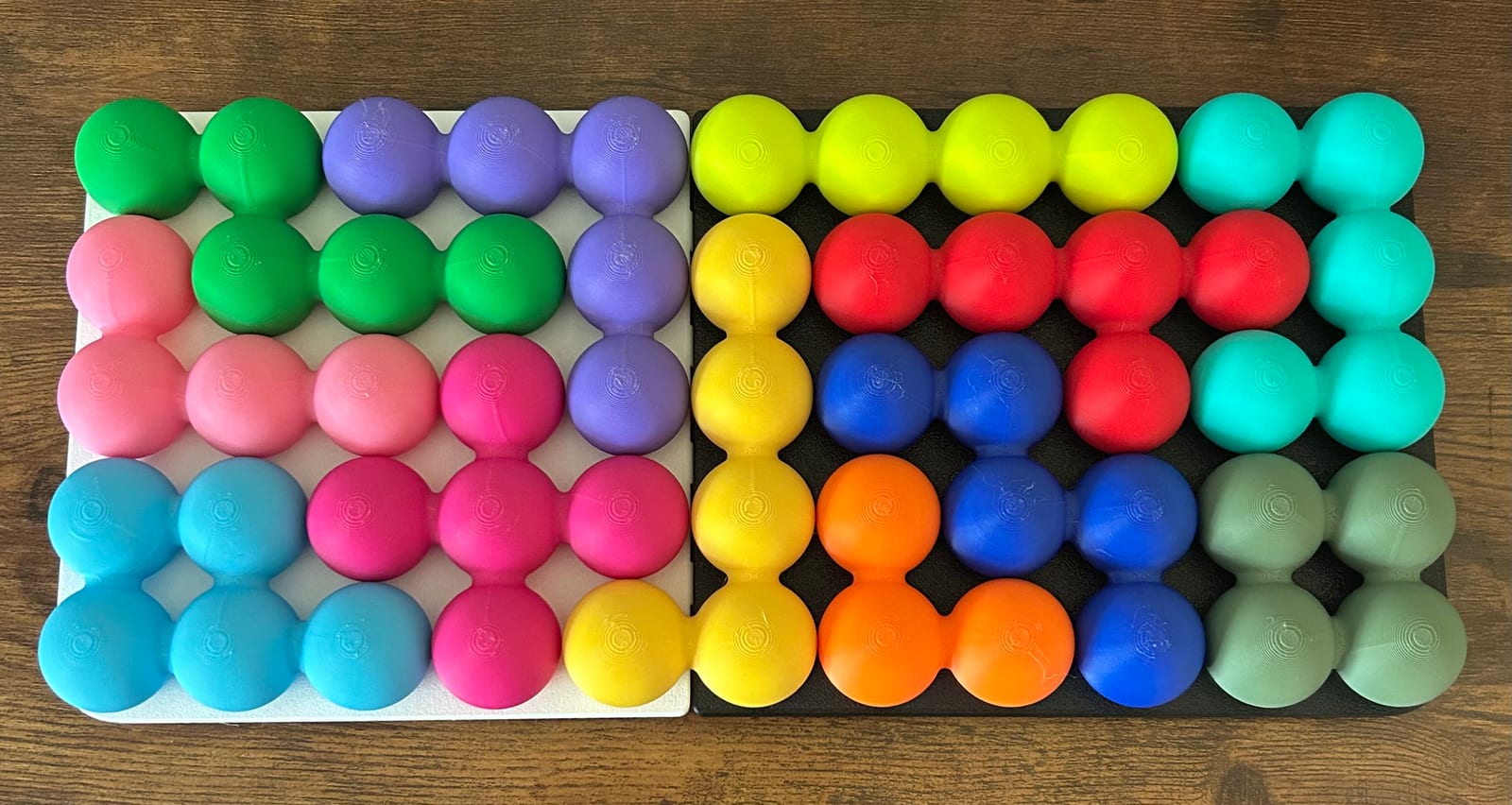
You have a Kanoodle in front of you, most of the board is filled, and the last piece will not go in. Somewhere in the booklet there is an answer, but flipping to the back does not tell you what you did wrong, and it will not help you on the next card either.
This is a guide to the reasoning, not the answers. We're publishing it because we design and hand-print a puzzle in the same family, and these are the exact moves we had to learn ourselves before we ever cut a piece. Learn the four below and you can solve puzzles in this family without looking anything up.
Stuck on a card right now? Our free Kanoodle solver finishes the board you enter, flat tray or pyramid. Color in your pieces and get a one-piece hint or the whole answer.
Does every Kanoodle puzzle have a solution?
Yes. Every challenge printed in the Kanoodle booklet has at least one valid solution. If your board will not close, the puzzle is not broken: a piece you placed earlier has left a gap that none of your remaining pieces can fill. The techniques below are about finding that piece quickly instead of starting over.
First, an honest note about the answer key
Kanoodle is made by Educational Insights, and the official solutions are printed in the back of the booklet that ships with it. If yours has gone missing, Educational Insights is the place to ask. We have not reproduced their answer key on this page and we do not intend to. It is their puzzle content.
What we do publish is the full solution set for our own puzzle. Katachi-Go is a spatial logic puzzle in the same family, designed and printed by Hoffmakers, and every one of its starting layouts and answers is free to browse at the Katachi-Go solutions guide. If you came here looking for an answer key, that is the one we can honestly give you.
If you are stuck on a specific card right now, our free Kanoodle solver works with the puzzle you already own: color in the pieces on your board and it finishes the rest, or reveals a single piece as a hint. It solves the board you enter; it does not reproduce the booklet.
Why the board fights you
Most people play these by trial and error: pick up a piece, try it, rotate it, try it again. That works on an easy card and falls apart on a hard one, because the number of ways to arrange a dozen bead clusters is far larger than you can search by hand.
It helps to be precise about what you are holding. The pieces are not pegs you move one at a time. Each is a rigid cluster of connected beads, a polysphere, that drops into the indented holes on the board, and every challenge locks a few of those clusters into fixed starting positions and leaves you to fill the rest. Those locked pieces are not decoration, they are the constraints the whole solution hangs on. The same is true across the wider family of tile-placement puzzles, including SmartGames' IQ Puzzler Pro and Lonpos.
The puzzles are solvable by deduction instead. At any moment there is usually one region of the board where only a handful of pieces could possibly fit. Find that region, and the puzzle stops being a search and starts being a chain of forced moves.
1. Start where the board is most constrained
Do not start in the middle. The middle is where the most pieces fit, which means it tells you the least.
Start in a corner, then work the edges. A corner cell can only be covered by a piece that presents a matching corner in some orientation, and often only two or three of your remaining pieces qualify. That is a short list you can actually reason through. Once the corner is committed, the cells beside it become constrained in turn, and the chain continues inward.
2. Count the holes before you commit
This is the technique that saves the most wasted time. After each placement, look at the empty space and ask whether it is still fillable.
- If a placement cuts off an isolated pocket of one or two cells, undo it. Check whether any piece you have left is actually that small; usually none is.
- If a region is walled off with, say, seven empty cells, check whether your remaining pieces can actually add up to seven. If no combination does, that region is dead and the placement that created it was wrong. In Kanoodle, a pocket of 1, 2 or 6 holes can never be filled, whatever pieces you hold; here's why, and which other sizes are dead.
- Watch for narrow necks. A one-cell-wide channel two cells long is almost always a mistake in disguise.
Checking a placement this way takes a few seconds. Discovering the same mistake nine pieces later costs you the whole board.
3. Place the awkward pieces early
Every set has a few shapes that are difficult to accommodate: the long straight one, and anything with a bend that only nests one way. Those pieces have the fewest legal positions, so they carry the most information.
Leaving them for last is the single most common way to lose a solve. By then the board is full of small irregular gaps, and an awkward piece fits almost none of them. Place your most constrained pieces while you still have room for them, and let the small, flexible pieces mop up at the end.
4. Backtrack two pieces, not one
When you get stuck, most people pull the last piece and try another orientation for it. That rarely works, because the last piece was usually forced by the one before it.
Pull two or three, and change the earliest one. You are looking for the decision that created the impossible gap, and that decision is normally a few moves upstream from where the failure showed up.
Practise on a board that shows its reasoning
The hard part of learning deduction is that a physical puzzle gives you no feedback. You cannot see whether a placement was forced or merely lucky until the board fails, and by then the evidence is gone.
Katachi-Go Virtual is free in your browser and shows clues directly on the board: markers indicating where specific pieces belong. It also enforces a rule that turns most boards into genuine deduction rather than trial and error, which is that a piece may not cover a clue belonging to a different piece. That one rule makes the forced-placement pattern visible while you are still learning to spot it.
There is a fresh puzzle every day in Today’s Trial if you want a short daily rep rather than a long session.
Frequently Asked Questions
Does every Kanoodle puzzle have a solution?
Yes. Every puzzle printed in the booklet has at least one valid solution. If a board will not close, the problem is a piece you already placed, not the puzzle itself. Take out the last two or three pieces and try a different orientation before assuming the challenge is broken.
Where can I find the official Kanoodle answer key?
The solutions are printed in the back of the booklet that ships with the puzzle. Kanoodle is made by Educational Insights, and replacement booklets and support come from them. We do not republish their answer key here.
Why will my Kanoodle puzzle not solve?
Almost always because an early piece left a gap that no remaining piece can fill. Count the empty holes in each isolated region: if a region has one, two, or any count that does not match the sizes of the pieces you have left, something placed earlier has to move.
What is the fastest way to get better at these puzzles?
Stop starting in the middle. Fill the most constrained part of the board first, usually a corner or an edge, because those spots have the fewest possible pieces that can cover them. Working from the constrained end turns guessing into deduction.
Is there a way to practise without the physical puzzle?
Yes. Katachi-Go Virtual is a free browser puzzle in the same family, with no download and no sign-up. It shows clues on the board, so you can practise reading a forced placement rather than fitting pieces until something works.
Try It Free
Every technique above is easier to learn on a board that actually tells you when a placement is forced – that's the whole reason we built Katachi-Go Virtual free and open, no download, no sign-up.