Educational Insights just supersized one of the most recognizable shape puzzles around. Kanoodle Party and Kanoodle XL take the classic 12-piece logic puzzle and blow it up to tabletop, then backyard, scale.
Because we design and build our own oversized puzzles, we wanted to look closely at how these two mass-market giants actually stack up, and explore whether a traditional trial-and-error puzzle is the right fit for your game night, or if you need a true logic puzzle instead. Here is what each game brings to the table.
Kanoodle Party: The Frantic Tabletop Game
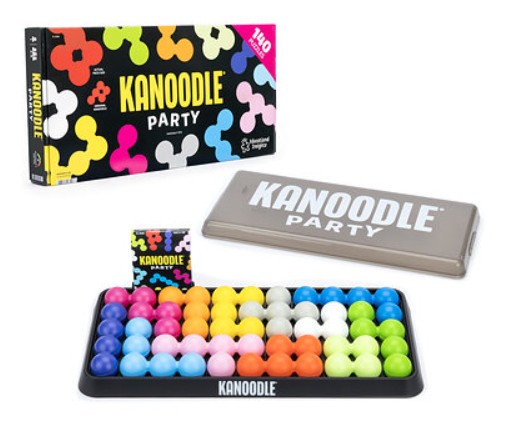
Kanoodle Party is a 15-inch tabletop board built for 1 to 4 players. The pieces are three times the size of the original Kanoodle set, making them chunky enough for a group to gather around.
Its signature feature is speed. The game introduces a turn timer: players scan a QR code to pull up a web timer, choose a 5 to 30-second window, and frantically try to place a piece before the buzzer sounds and forces the turn to the next player. The set ships with 100 puzzles in the included guide.
Kanoodle XL: The Outdoor Edition
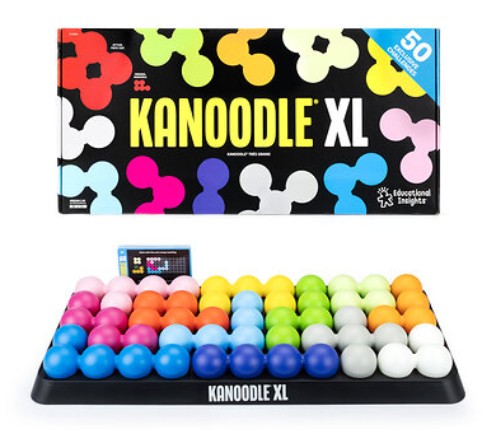
Kanoodle XL goes even bigger: a 30-inch board with 12 extra-large pieces, explicitly built to be portable for parks, beaches, and backyards rather than a quiet game night. It comes with 25 double-sided challenge cards and a mesh storage bag for hauling it outside.
The Difference: Trial & Error vs. Pure Logic
Both Kanoodle Party and Kanoodle XL are "packing puzzles." You fit connected-ball pieces together by guessing, relying on trial and error until everything clicks into place. They are simple to understand and great for fast-paced, high-energy settings with kids.
But if you want a puzzle that makes you think rather than guess, you need a deduction puzzle. That is why we built Katachi-Go.
Katachi-Go is an oversized, 3D-printed spatial puzzle crafted directly in our Hoffmakers workshop. Instead of relying on a buzzer to force the action, Katachi-Go gives you clues. Every puzzle has exactly one correct solution, and you use pure logic to reason your way to the answer, just like a 3D, full-color Sudoku. It features 12 precise polyomino pieces that slot into a structured 5x11 grid board, creating a striking display piece designed for puzzle enthusiasts rather than the toy aisle.
How They Compare
| Feature | Kanoodle Party | Kanoodle XL | Katachi-Go |
|---|---|---|---|
| Solving Method | Trial & Error (Guesswork) | Trial & Error (Guesswork) | Pure Logic & Deduction |
| Gameplay Pace | Frantic (5–30 second buzzer) | Untimed | Relaxed, at your own speed |
| Build Quality | Mass-produced plastic | Mass-produced plastic | Premium 3D-printed, handmade |
| Board & Pieces | 15-inch board, connected-balls | 30-inch board, connected-balls | 5x11 grid board, 12 polyominoes |
| Target Audience | Kids and party games | Outdoor gatherings | Puzzle enthusiasts and gift-givers |
| Added Value | 100 physical puzzles | 25 physical puzzles | Free digital companion (5,000 puzzles) |
Which Puzzle Is Right for You?
If you are looking for a fast, stressful party game or a giant plastic toy to drag to the beach, Kanoodle Party and Kanoodle XL are solid, mass-market options.
But if you want a premium, made-to-order puzzle that challenges your brain with genuine deduction, and looks beautiful sitting on your coffee table, Katachi-Go is in a category of its own. If the size is what draws you to the XL, here is why a giant Kanoodle is more fun when it solves by logic. For a feature-by-feature matchup, see Kanoodle Party vs. Katachi-Go.