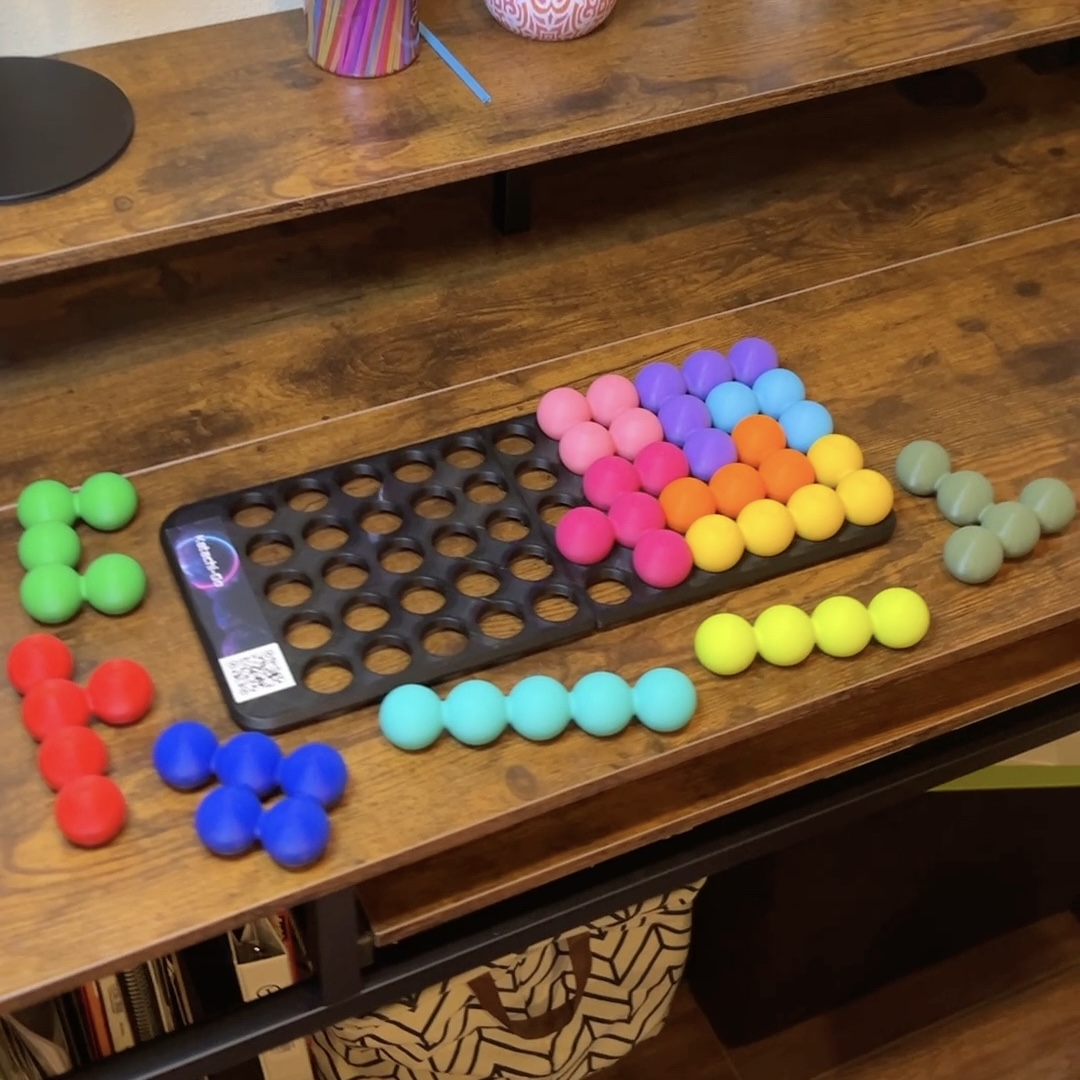
Every Kanoodle player hits the moment eventually. Eight or nine pieces are down, three are left in your hand, and none of them will go in. You rotate, you flip, you try the other corner. Nothing. So you start to wonder whether this one even has an answer.
It almost certainly does. But the question is a good one, because the honest answer has three parts, and the third one is the useful part: it explains why you got stuck and how to see it coming next time.
The short answer
- Every challenge in the book can be solved. Each one has a published answer.
- It won't always have only one solution. The printed answer is an answer, not necessarily the only one.
- Your own half-finished board can become impossible. One misplaced piece can leave a gap that nothing left in your hand can fill.
So when a Kanoodle feels impossible, the challenge is almost never the problem. A piece you added along the way is.
Every challenge in the book has an answer
Kanoodle comes with a booklet of challenges, each showing a few pieces already in the tray, and the answers are printed in the back. That settles the first question directly. If a challenge has a printed answer, it is solvable by definition, no matter how stuck you feel.
The same goes for the pyramid challenges. Stacking is harder to picture than filling a flat tray, but a printed pyramid challenge has a printed answer just the same.
One answer, but not always the only one
Early challenges leave only a few pieces to place, in a gap so tight there is often just one way to finish. Further into the book, with fewer pieces starting on the board, there is far more room to maneuver, and it's common to fill the tray with a layout that doesn't match the printed answer at all.
That still counts. Kanoodle's only rule is that every hole is filled and every piece is used. If you managed that, you solved it, whatever the back of the book says. It also means the printed answer is a poor way to check your progress mid-solve: a board that doesn't match the book may still be perfectly finishable.
If you'd rather play a puzzle where there is exactly one right answer, and you can reason your way to it, that's a different kind of puzzle altogether. More on that below.
How a board becomes impossible
Here is where “is Kanoodle always possible?” gets a real no. The challenge is always possible. The board you've built on top of it doesn't have to be.
Every piece you place splits the empty space a little further. Place one badly and you wall off a pocket: a group of empty holes, connected side by side, closed in by pieces and the tray's edges. Once that pocket exists, it has to be filled by some combination of the pieces you still hold. If no combination fits, the board is dead, and no amount of rotating the last piece will save it.
The good news is that a lot of dead pockets can be spotted with simple arithmetic, before you waste ten minutes on them.
The pocket-counting trick
Kanoodle's twelve pieces aren't all the same size. There is one piece of 3 balls, three pieces of 4 balls, and eight pieces of 5 balls, which is exactly the 55 holes in the tray. Every pocket on your board has to be filled by some of those pieces, so its size has to be a number you can build by adding 3s, 4s and 5s from what you have left.
Some numbers can't be built at all:
While the 3-ball piece is still in your hand, a pocket of 1, 2 or 6 holes can never be filled. One and two are smaller than any piece. Six would need two 3-ball pieces, and there is only one.
Once the 3-ball piece is on the board, the list grows to 1, 2, 3, 6, 7 and 11, plus 16, 21, 26 and every size five higher. Those last ones are each one more than a multiple of five, and building them from 4s and 5s takes four 4-ball pieces. You only have three.
That list assumes you still hold all three 4-ball pieces. If some are already down, even more sizes become unreachable. The rule doesn't change, though: count the pocket, then ask whether the pieces you have left can add up to it exactly.
One thing that makes this easier than it sounds: the empty space on your board always adds up to exactly the pieces in your hand, because the tray has 55 holes and the pieces have 55 balls. So a single open area never fails the count. The check only matters once the empty space has split into two or more separate pockets. That's exactly when it's worth doing.
Shape can still sink you
Passing the count doesn't guarantee a pocket can be filled. A pocket of 5 holes is only fillable if one of your remaining 5-ball pieces actually has that shape, and a long one-hole-wide corridor rejects almost everything. A few patterns that are dead far more often than not:
- A single empty hole tucked into a corner or against the tray's edge.
- A long, thin corridor exactly one hole wide.
- A pocket whose shape matches none of your remaining pieces in any rotation or flip.
The best habit is to look for new pockets right after every placement, not when you're down to your last piece. If a placement creates one that fails the count, take it straight back out. For the rest of the deduction toolkit, our Kanoodle solutions guide walks through how to find the most constrained spot on the board and work outward from it.
What about the pyramid?
The same logic applies when you stack. A pyramid has layers, and a gap in a lower layer that no remaining piece can reach or fill is just as dead as a sealed pocket in the flat tray. It's harder to see, because pieces in pyramid mode can climb between layers, but the question is the same: can what's left in your hand still cover exactly what's left empty?
Want a puzzle with exactly one solution?
That's what we built Katachi-Go to be. It is a 5×11 tray puzzle in the same family as Kanoodle, but it is not the same set: Katachi-Go has its own twelve shapes, and several of them aren't in Kanoodle at all. The piece sizes do line up (one 3-ball piece, three 4-ball pieces and eight 5-ball pieces), and since the pocket-counting trick only cares about sizes, it works on Katachi-Go too.
The real difference is the clues. Every Katachi-Go puzzle shows clues on the board marking where specific pieces belong, and a piece can never cover another piece's clue. Those two rules together mean every puzzle has exactly one correct solution, and they let you reason your way to it instead of guessing. Kanoodle asks does something fit here? Katachi-Go asks what has to go here? If that sounds like Sudoku, that's the idea. We walk through a full example in how to solve a shape Sudoku.
Frequently Asked Questions
Does Kanoodle always have a solution?
Every challenge printed in the Kanoodle booklet has a solution, and the answer is printed in the back of the book. What does not always have a solution is a board you have partly filled yourself. A single misplaced piece can seal off a gap that no remaining piece can fill, and from that point the board cannot be finished until you take pieces back out.
Can every Kanoodle puzzle be solved?
Yes, as long as you start from the challenge as printed. Each one has at least one published answer, so it is solvable by definition. If a challenge feels impossible, the problem is almost always a piece you added along the way, not the challenge itself.
Is Kanoodle always possible if I place pieces randomly?
No. Random placements dead-end all the time. The quickest check is to count the holes in any walled-off gap. A gap of 1, 2 or 6 holes can never be filled with the standard piece set, because the pieces are made of 3, 4 or 5 balls and there is only one 3-ball piece.
Does each Kanoodle challenge have only one solution?
Not necessarily. The booklet prints one answer per challenge, but on harder levels, where fewer pieces start on the board, you can often finish with a different arrangement that also fills every hole. If every hole is filled and every piece is used, you solved it, whether or not it matches the book.
Is there a puzzle like Kanoodle with only one solution?
Yes. Katachi-Go is a 5 by 11 tray puzzle in the same family, with its own set of twelve shapes. Clues on the board show where pieces belong, and a piece can never cover another piece's clue, so every puzzle has exactly one correct solution that you can reason your way to. You can play it free in your browser at hoffmakers.com/katachi-go.
Try It Free
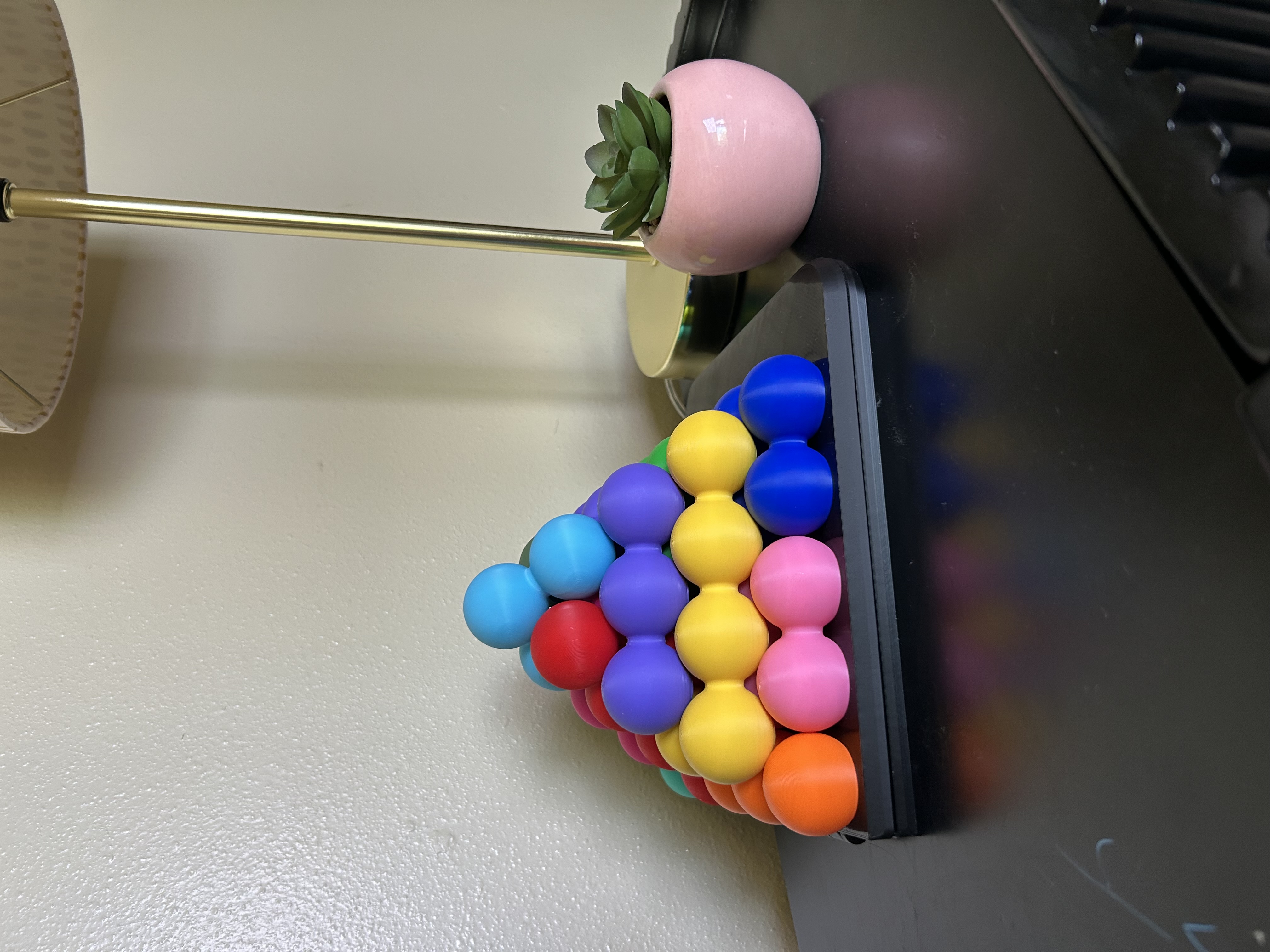
If you'd like a puzzle that always has exactly one answer, Katachi-Go Virtual is free in your browser with no download and no sign-up, with thousands of clue puzzles and a new daily puzzle every day. There is a giant 3D-printed physical set too, with a full solutions guide of its own.
Katachi-Go
Clue puzzles with exactly one solution. Free in your browser, or order the giant physical set