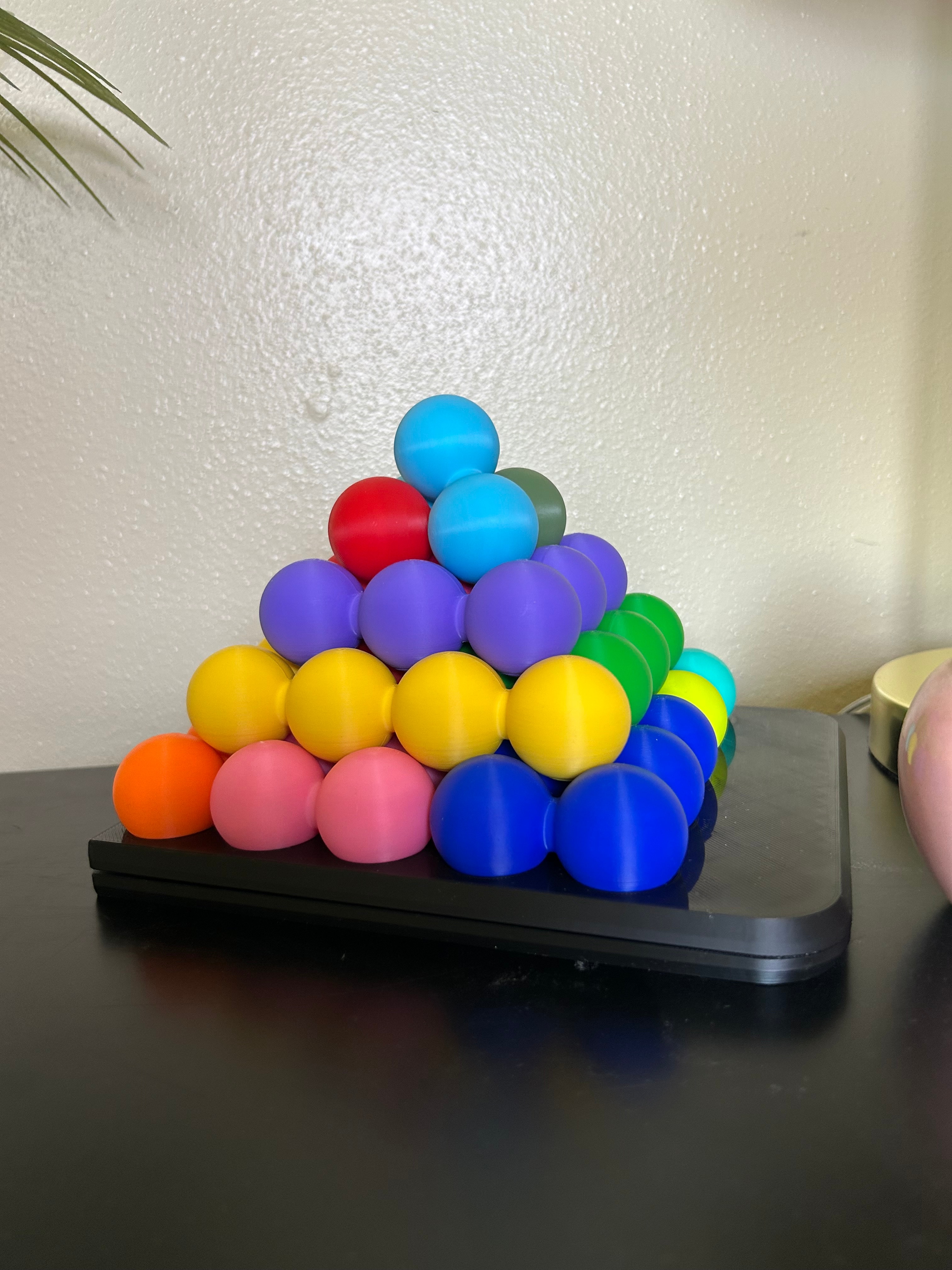
Most shape puzzles work the same way. You're handed a tray, a pile of oddly-shaped pieces, and a grid to fill. There's no starting information, no clues, nothing telling you where anything goes. You just start trying pieces until something fits. That's not a flaw, it's the whole game: a packing puzzle, solved by trial, error, and a decent sense for shapes.
We built Katachi-Go to look like it belongs to that same family: a colorful, Kanoodle-style tray of sphere-cluster pieces. But the moment you see a translucent clue sphere sitting on the board before you've touched a single piece, the game changes underneath you. Instead of guessing, you're told. And once you're told, the rest of the board opens up to logic, more like solving a Sudoku than packing a suitcase.
Packing Puzzles vs. Deduction Puzzles
A packing puzzle only asks one question: does it fit? There's no "correct" starting point, and it's completely normal for the same tray to have several different valid arrangements. Success just means every piece is placed and nothing overlaps. That's how the classic Kanoodle plays, and it's a genuinely fun kind of puzzle, spatial reasoning with your hands, no wrong answers along the way.
A deduction puzzle asks a different question: given what you already know, what has to be true? Sudoku is the most familiar example, a handful of starting numbers constrain everything else, so you're never really guessing, you're reasoning forward from a fixed set of facts. Katachi-Go borrows that structure and builds it into a 3D shape puzzle.
What a Clue Actually Does
Every missing piece in a Katachi-Go puzzle gets a clue: one translucent sphere placed at that piece's true position on the board, before you've moved anything. It's not the whole piece and it's not its orientation, just an anchor point, the same way a Sudoku puzzle hands you a handful of starting numbers instead of a blank grid. From there, you're not guessing where the rest of that piece goes, you're reasoning your way there: which shapes could touch that clue, which orientations actually fit the surrounding cells, what the other clues and already-placed pieces rule out along the way. You'll often know a placement is right before you've committed to it, the same confidence a well-built Sudoku rewards.
Here's the part that actually makes it work: a clue isn't just a suggestion, it's a fact you're not allowed to argue with. Once a sphere is showing for one piece, no other piece can cover that cell — try anyway and the board pushes back, a quick shake and a reminder that the cell belongs to someone else. That one rule is what turns "helpful hint" into a real logical constraint, the same way a Sudoku puzzle's given numbers aren't decoration, they're facts the rest of the grid has to respect. Filling every cell isn't enough anymore; the board has to actually agree with every clue you can see.
Every puzzle has exactly one solution — because no piece may cover another piece’s clue, even a completely empty board can be reasoned out through logic, not guesswork. At Easy difficulty every missing piece gets a clue, even on the tray's hardest tier where all 12 pieces are missing at once.
Solving a Clue, Step by Step
Here's what that looks like on a real board. Say two clues are showing near the top-left corner: one two cells in from the edge, another three cells further right. Nothing else is filled in yet. On a packing puzzle those are just two colored dots you'd ignore until you got around to them. On Katachi-Go, they're the whole opening move.
Start with the piece whose shape actually rules something out. Say the left clue belongs to a five-cell piece shaped like a shallow hook: four cells in a row with one more stepping down at the end. Try laying that hook flat, running rightward from its clue — the fourth cell would land directly on the second clue, and a cell can only belong to one piece. That orientation is out, not because it looks wrong, but because it contradicts a fact you were already handed. Flip the hook to run the other direction instead, and the collision disappears. You haven't guessed which way it goes. You've eliminated every other option until one was left.
That's the same move a Sudoku solver makes scanning a row for a stranded candidate: check what a cell's neighbors already rule out, then see what's left standing. In Katachi-Go the neighbors are the other clues and the pieces already on the board, and the candidate is an orientation instead of a digit, but the reasoning is identical. Place one piece this way and it usually narrows the next one down the same way, one clue at a time, until there's nowhere left for a guess to even start.
A Rule You Can Check Yourself
A published Sudoku puzzle makes a real promise: there is exactly one way to fill in the grid. Katachi-Go makes the same promise, and rather than ask you to just take our word for it, the proof is a rule you can go test on the board right now. Try to force a piece onto a cell that's already showing a clue for something else, and it won't go there. Not "it's discouraged," not "it costs you points," it simply isn't a legal move.
That single rule is what turns "every puzzle has exactly one solution" from a marketing line into something mechanical: once every clue on the board has to be respected, not just filled around, there's nowhere left for a second valid answer to hide. Filling every cell was never the hard part; agreeing with every clue you can see is.
Try It Yourself
You don't have to take our word for any of this. Play Katachi-Go free in your browser right now, no download and no sign-up. Grab any piece and try to drop it on top of a translucent clue that belongs to a different piece — the board will shake and hand it right back. Then place the clue-adjacent pieces first instead, and watch the rest of the board actually fall into place through logic, not luck.
Katachi-Go
The Sudoku of shape puzzles. Free to play, right in your browser. No download, no sign-up.