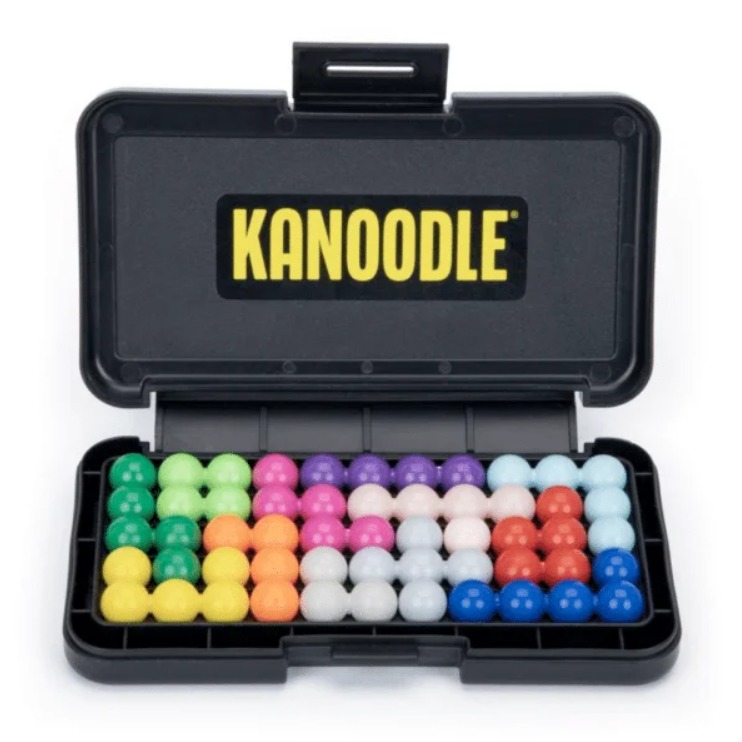
Pick up a Kanoodle and the design feels like folk geometry, the sort of thing that has simply always existed. Twelve pieces of fused plastic balls. A shallow tray of round dimples. Fill the tray flat, or stack the same twelve pieces into a pyramid. It has the anonymous, unauthored quality of a deck of cards.
It is not anonymous at all. Somebody filed for it, twice, and both filings are public and readable. The trail runs through Taiwan rather than the United States, it spans ten years rather than a single moment of invention, and the patent most often cited online as the origin turns out to be the wrong one.
The short answer
The mechanic comes from a Taiwanese inventor working through Lonpos Braintelligent, a puzzle company based near Taipei. Educational Insights publishes Kanoodle, and publishes it well, but it did not originate the design. Kanoodle is the later commercial version of a puzzle Lonpos was already selling as Lonpos 101, with the same twelve pieces filling the same fifty-five holes.
One caution on the name. The 1989 filing lists its inventor as Ming S. Cheng, elsewhere rendered Ming Shean Cheng, filing as a private individual. The Lonpos patents that follow name Ming-Hsien Cheng. Those are plausibly the same person under different romanisations of the same Chinese name, but nothing in the public record states it outright, so treat the connection as likely rather than established.
The 1989 patent everyone cites
The document usually offered as the origin is US Patent 4,988,103, titled “Geometric puzzle of spheres.” It was filed on 2 October 1989 and granted on 29 January 1991. Its abstract describes puzzle pieces “composed of an equal number of balls joined together,” which is unmistakably the right family.
Read the claims, though, and it is not the puzzle on your shelf. The patent describes seven pieces of five balls each, thirty-five balls in total. The shapes you are asked to build are a flat triangle, a flat elongated hexagon, and a solid tetrahedron, which is a pyramid with a triangular base. There is no rectangular tray. There is no square-based pyramid. Twelve pieces appear nowhere in it.
So the 1989 patent is genuinely the ancestor. It establishes the core idea of fusing spheres into rigid pieces that nest into a moulded base. It is simply not yet the specific puzzle that Kanoodle would become.
The patent that is actually your puzzle
That one arrives ten years later. US Patent 6,220,919 was filed on 4 October 1999, granted on 24 April 2001, and assigned to Lonpos Braintelligent, with Ming-Hsien Cheng named as inventor. Its title is uninformative to the point of camouflage, all about geometric shapes with corners of sixty, ninety and a hundred and twenty degrees.
The description is not camouflaged at all. It sets out “a rectangular building block seat 20 with 55 (5×11) round holes,” and states that “12 unit assemblies” will “fill completely the round holes.” It allows the individual units to be ball-shaped. It covers stacking the pieces into pyramids. Twelve pieces, fifty-five balls, a five-by-eleven tray: that is the puzzle, described in the patent office's own words.
It also lists the 1989 patent among its cited references, which is what makes the lineage a matter of record rather than a reasonable guess. One filing leads to the other on paper.
Twelve pieces, fifty-five balls, a 5×11 tray. Those numbers are not a design convention that emerged over time. They are written into a patent filed in October 1999, and every puzzle in this family since has inherited them.
When it entered the public domain
Neither patent is live. The 1989 filing lapsed in October 2009. The 1999 filing, the one that matters, ran its term and expired in October 2019.
That expiry is why the category looks the way it does now. Kanoodle, SmartGames' IQ Puzzler Pro and a long tail of similar sets can all use the mechanic because the mechanic itself is no longer owned by anyone.
Worth being precise about what that does and does not mean. An expired patent frees a mechanism, not a name. Kanoodle remains a trademark of Educational Insights and Lonpos remains a trademark of Lonpos. The geometry is public; the brands are emphatically not.
The mathematics came first, and nobody ever owned it
Underneath the moulded plastic sits a much older question, and one that was never patentable. In 1953 the mathematician Solomon Golomb gave a talk to the Harvard Mathematical Club in which he coined the word “polyomino” for a shape made of squares joined edge to edge. He published the idea in 1954, Martin Gardner carried it to a wide audience in Scientific American in 1957, and Golomb's book Polyominoes followed in 1965.
Everything the Kanoodle family asks of you is a polyomino tiling question wearing a plastic costume. Can this set of shapes cover this region exactly, with no overlaps and no gaps? Cheng patented an implementation, spheres and a dimpled tray and a particular set of twelve pieces. The question the implementation poses belongs to mathematics, and mathematics is not something you can file for.
One piece of vocabulary is worth getting right, because most writing on these puzzles gets it wrong. Squares joined edge to edge are polyominoes. Spheres fused into a rigid cluster are polyspheres. The pieces in your Kanoodle set are polyspheres; the footprint one of them leaves in the tray is a polyomino.
How a computer solves one
Filling the tray is a textbook instance of what mathematicians call an exact cover problem. You have a collection of candidate placements, each covering some subset of the fifty-five holes, and you need to choose a group of them that covers every hole exactly once. Sudoku, the eight queens problem and pentomino tilings are all the same problem in different clothes.
The standard method is Algorithm X, a recursive backtracking procedure published by Donald Knuth, usually implemented with the Dancing Links technique he described in 2000. It works by repeatedly picking the most constrained remaining hole, trying each piece that could cover it, and unwinding cleanly when a branch dies. That is a formal version of exactly the advice good human solvers give: start where the board has the fewest options.
The free game on this site is built on an Algorithm X solver, and the same solver code runs in two places. It works out the full board solutions the puzzle set is generated from, and a copy of it ships to your browser to compute the clues while you play.
We have also put that solver to work on Kanoodle itself: the free Kanoodle solver takes the pieces already on your board and finishes the 5×11 tray in a fraction of a second.
Frequently Asked Questions
Who invented Kanoodle?
Educational Insights publishes Kanoodle, but it did not originate the design. The mechanic traces to a Taiwanese inventor credited as Ming S. Cheng on a 1989 US filing and as Ming-Hsien Cheng on the later patents assigned to Lonpos Braintelligent. The specific twelve-piece, fifty-five-ball layout that Kanoodle uses is described in US Patent 6,220,919, filed in 1999.
Is Kanoodle the same puzzle as Lonpos?
They share the same geometry. Lonpos came first, and its Lonpos 101 set uses the same twelve pieces filling the same 5 by 11 tray of fifty-five holes. The two are different brands from different companies, and the piece colours and challenge booklets differ, but the underlying puzzle is the same one.
Is the Kanoodle patent still in force?
No. The 1989 patent, US 4,988,103, expired in October 2009. The patent that actually describes the 5 by 11 tray, US 6,220,919, expired in October 2019. Both are lapsed, which is why several companies now sell puzzles built on the same mechanic. Expired patents free a mechanism, not a brand name.
Did Kanoodle invent the pyramid mode?
No. Stacking the same pieces into a pyramid appears in the original 1989 patent, though there the target shape is a tetrahedron with a triangular base rather than the square-based pyramid used today. The square-based version appears in the 1999 Lonpos patent alongside the rectangular tray.
What is a polysphere?
A polysphere is a rigid piece made of spheres fused together, which is what every piece in this family of puzzles actually is. It is the sphere-based cousin of a polyomino, the term Solomon Golomb coined in 1953 for shapes made of squares joined edge to edge. Flatten a polysphere onto one layer and its footprint is a polyomino.
Try It Free
Thirty-five years of patent history is a lot of context for what is, in the end, a very good puzzle. If you would rather play one than read about one, Katachi-Go Virtual is free in your browser with no download and no sign-up, and it will show you its reasoning while you solve.