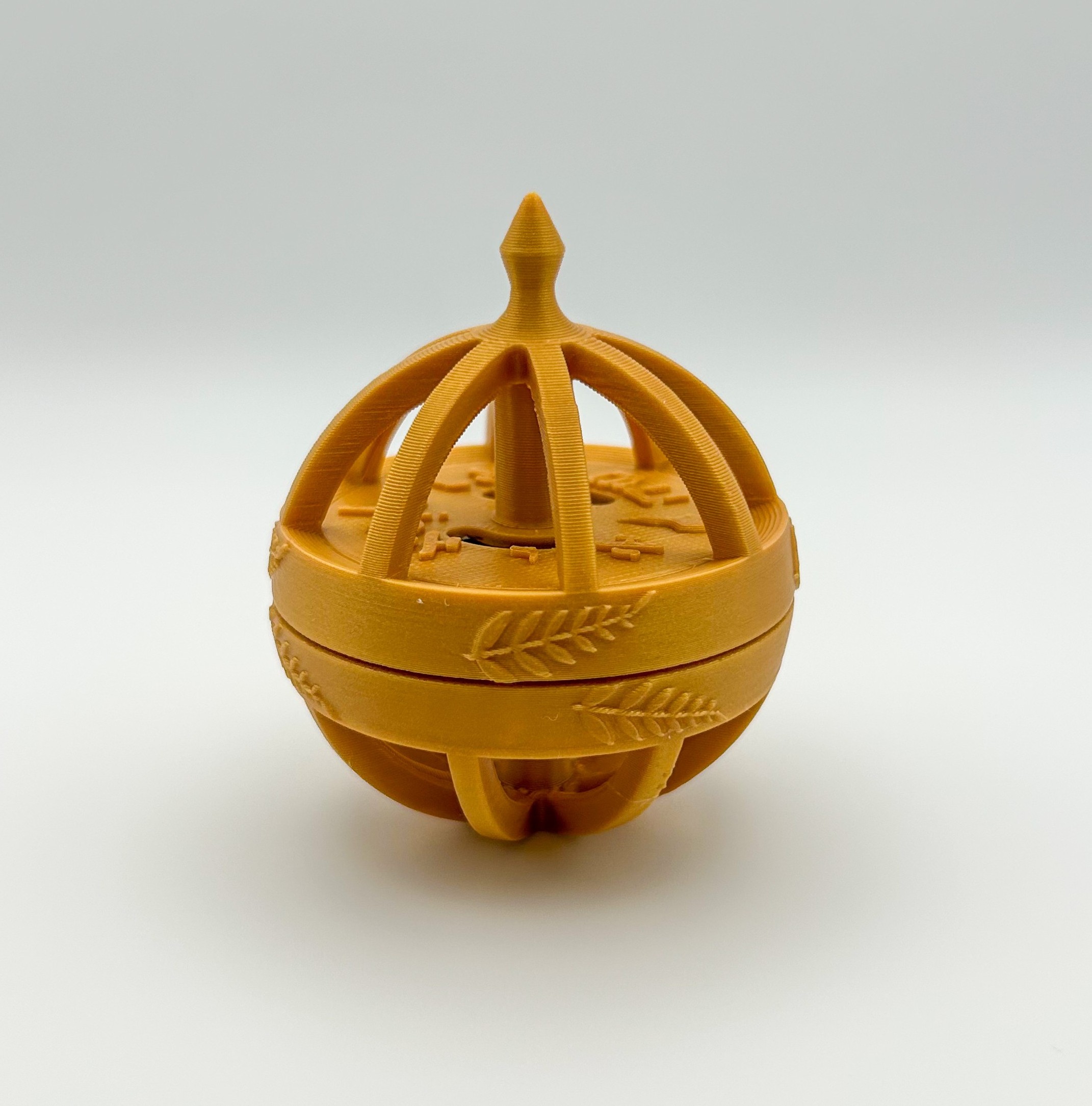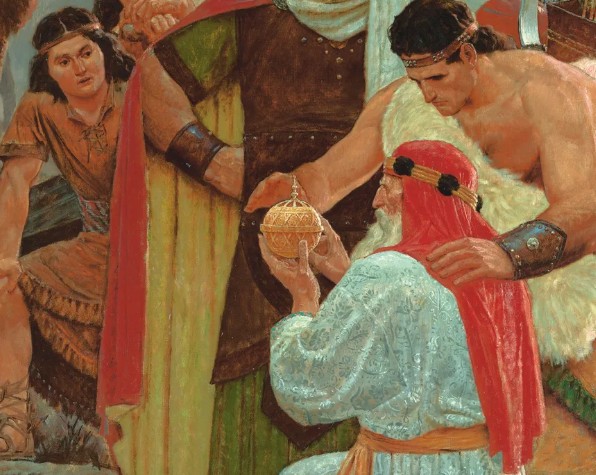
The Liahona is more than a directional tool in an ancient survival story. It's one of the most layered and often-quoted symbols in the Book of Mormon, and its meaning reaches far beyond the pages it's found in.
Here's what the Liahona actually is, where it shows up in the text, and what it's come to represent.
What Is the Liahona?
The Liahona was a round instrument that Lehi found just outside his tent door while his family camped in the wilderness after leaving Jerusalem, described in 1 Nephi 16. Scripture describes it as made of fine brass and "of curious workmanship," and 2 Nephi 5:12 describes it as prepared for Lehi by the hand of the Lord. Inside the ball were two spindles, one of which pointed the direction Lehi's family should travel. As the family made their way through the Arabian desert and eventually across the ocean to the promised land, that spindle kept pointing the way.
Interestingly, the name "Liahona" itself only appears once in the entire Book of Mormon, in Alma 37:38. Throughout most of the text, it's usually referred to as "the ball," "the compass," or "the director." (1 Ne. 16:16, 26-27; 1 Ne. 18:12; Alma 37:43-44; Mosiah 1:16; cf. D&C 17:1)
A Medium for Communication, Not Just Direction
The Liahona did more than point the way. At different points during the journey, written messages appeared on the ball itself, giving Lehi's family specific instructions for their situation. In that sense, it functioned as a kind of two-way communication tool between God and the family, not just a passive dial.
What made the Liahona remarkable wasn't its mechanism, it was how it worked. The instrument operated according to the faith, diligence, and obedience of the people using it. When Lehi's family was faithful and attentive, it worked. When they grew careless, complained, or acted in pride, the spindles stopped, and the Liahona gave no direction at all.
That single detail is why the Liahona has become such an enduring symbol. It isn't a compass that simply points north. It responds to the condition of the person holding it.
The Symbol of Faith and Diligence
The most direct interpretation comes from within the Book of Mormon itself. In Alma 37, Alma explains the Liahona to his son Helaman in explicitly symbolic terms, connecting the "small means" of the ball to the way small and simple things can bring about significant outcomes, and tying its function directly to faith.
The lesson embedded in the object is straightforward but easy to forget in daily life: guidance requires attention. The Liahona didn't run on autopilot, and neither, the text suggests, does personal direction in general. Diligence and faith are what keep the pointers moving.
The Liahona as a Symbol of the Word of Christ
Alma takes the symbolism a step further, comparing the Liahona directly to scripture. In Alma 37:45, he teaches that just as the Liahona carried their ancestors to the promised land by following its course, the words of Christ will carry the faithful toward a far better promised land, if they're willing to follow that course too. This comparison is part of why the Liahona shows up so often in talks and lessons about scripture study: it's used as a physical stand-in for an abstract idea, that guidance is available, but it takes active engagement to receive it.
More Ways the Liahona Has Been Used as a Symbol
Beyond the word of Christ, the Liahona has been used over the years to represent several other forms of guidance, each one drawing on a slightly different detail from the original story.
The Holy Ghost and personal revelation. The Liahona only worked when Lehi's family exercised faith and diligence, and that detail is often applied to how the Holy Ghost operates day to day. Rather than a one-time answer, it's described as quiet, continuous, and individualized direction that depends on a person's ongoing attention and loyalty, not a single request for help.
The Light of Christ, or conscience. The Liahona was given to guide travelers who were genuinely lost in unfamiliar territory, which makes it a natural symbol for conscience itself: the innate sense given to every person to help distinguish right from wrong while navigating everyday decisions.
Patriarchal blessings. The writing that occasionally appeared on the Liahona changed to fit the family's specific situation in the moment. Church leaders have drawn a comparison between that detail and a patriarchal blessing, a personal, written blessing that functions as an individualized compass for someone's particular life path.
The words of modern prophets. The Liahona was a physical instrument that kept a group of people aligned with God's will during a genuinely difficult, disorienting stretch of their journey. That same idea gets applied to living prophets and apostles today, who are sometimes described as functioning like a modern Liahona: offering timely warning, correction, and direction through complex, fast-changing circumstances.
Taken together, these interpretations aren't competing readings so much as layers. The same simple object gets applied to scripture, personal revelation, conscience, individual blessings, and prophetic guidance because the underlying pattern (guidance that requires faith and attention to receive) shows up in all of them.
A Sacred Object, Passed Down and Preserved
The Liahona wasn't a one-generation tool. It was passed down along with the sacred records that eventually became the gold plates, kept and preserved across generations as part of that same collection of sacred items. Its significance carried well beyond the Book of Mormon's own timeline: in 1829, the Liahona was shown to the Prophet Joseph Smith and the Three Witnesses alongside the plates themselves, according to Doctrine and Covenants 17:1. That detail underscores just how central this small object was considered, not a footnote to the story, but a physical witness kept alongside the record itself.
Why the Liahona Resonates Beyond the Story Itself
Part of what makes the Liahona endure as a symbol is how relatable its central tension is. Nobody wants a tool that requires ongoing attention and effort; most of us would prefer a fixed answer we can check once and trust forever. But the Liahona's design pushes back on that. It asks for continued engagement, not a one-time reading.
That's likely why the Liahona shows up constantly as a metaphor in talks about missionary work, personal revelation, and staying spiritually engaged day to day. It's a small, physical image for a much bigger idea: that guidance is ongoing, responsive, and tied to effort rather than a single request.
Not About Perfection
The Liahona worked according to faith, not moral perfection. The Book of Mormon rarely treats worthiness as an inherent moral status possessed by individuals. Rather, using the language and meanings common to the early nineteenth century, it presents being "worthy" primarily as being fit, prepared, qualified, or approved to receive God's gifts through faith in Christ, while simultaneously insisting that every human soul possesses infinite worth because of God's redeeming love.
A Symbol Worth Carrying
Because the Liahona represents something so personal (faith, attentiveness, and the daily choice to stay engaged) it's become a popular symbol for gifts tied to spiritual milestones: baptisms, missionary farewells, seminary graduations, and other moments when someone is stepping into a new stretch of their own path.
That's part of why we designed our Liahona Fidget Spinner, a small, spinning tribute to the compass itself, meant to be a quiet, tactile reminder of the story and what it represents, in something that fits in a pocket.